Scripting
Script Types
Peakboard uses Lua as its scripting language. Scripts are always attached to one of the following script types, which determine when a script runs. They appear as folders under [Scripts] in the explorer.
![The script types under [Scripts] in the explorer](/assets/images/scripting/types/script-types-01-scripts-tree.png)
From top to bottom these are [Timer] (1), [Functions] (2), [Global events] (3), [On screen activation] (4), [After data reload] (5) and [For controls] (6) – each is described below.
Timer
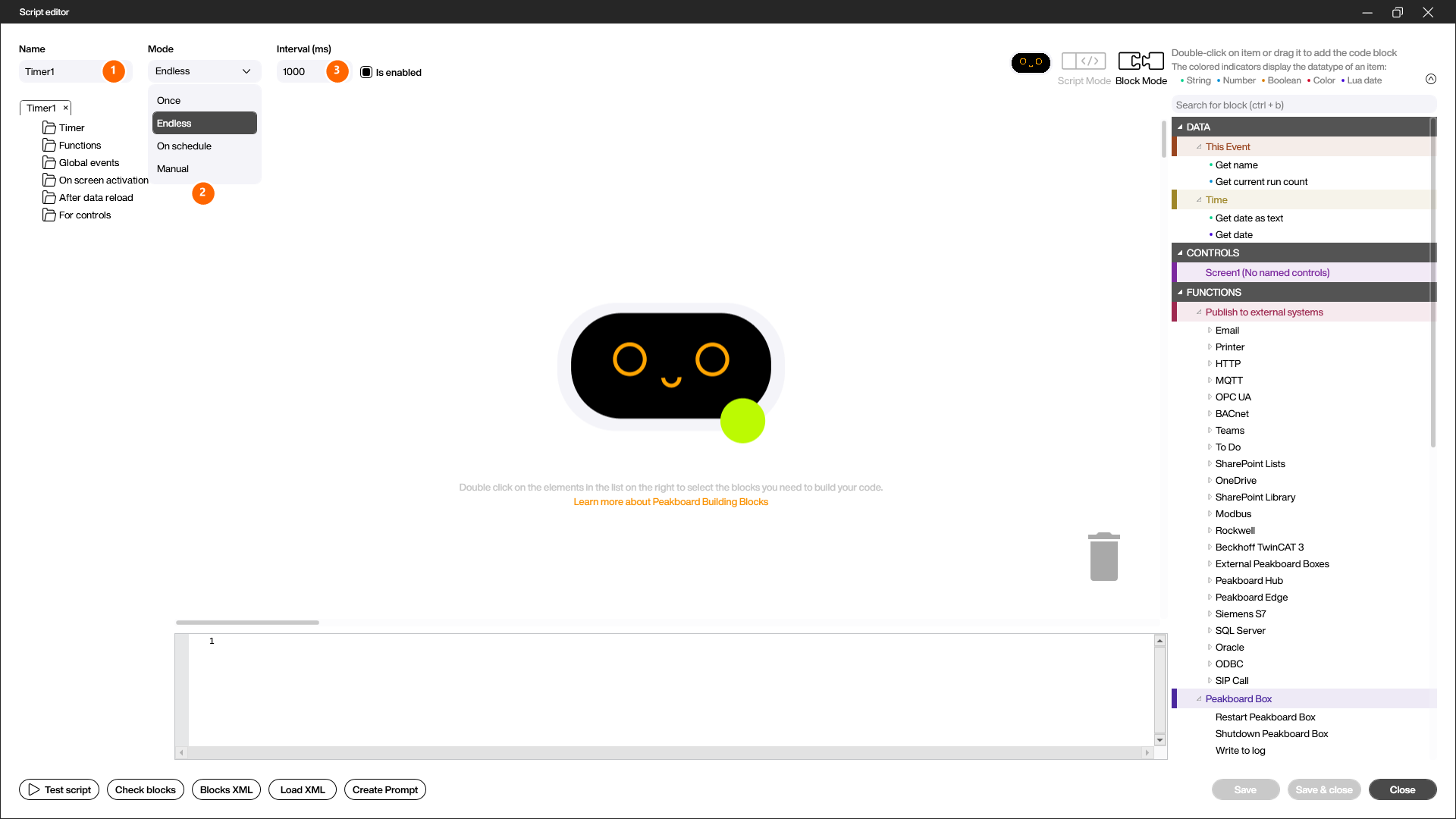
A timer script has a name (1), a mode (2) and an interval in milliseconds (3). The mode determines how it fires:
- Endless – repeats indefinitely at the specified interval.
- Once – fires once after the interval, then stops.
- Manual – does not fire automatically; it is started from a Lua script. When started, it fires once after the configured interval as a delay.
- On schedule – fires according to a day-of-week and time-of-day schedule.
Functions
Here you define reusable Lua functions. Every script (timer, event, activation script …) runs in its own isolated scope, so a function written inside one script cannot be called from another. A function defined under [Functions] is the mechanism to share logic across all scripts and to avoid duplicated code – you write it once and call it everywhere with MyFunction().
When you add a function under [Functions], the [Edit function script settings] dialog opens first:
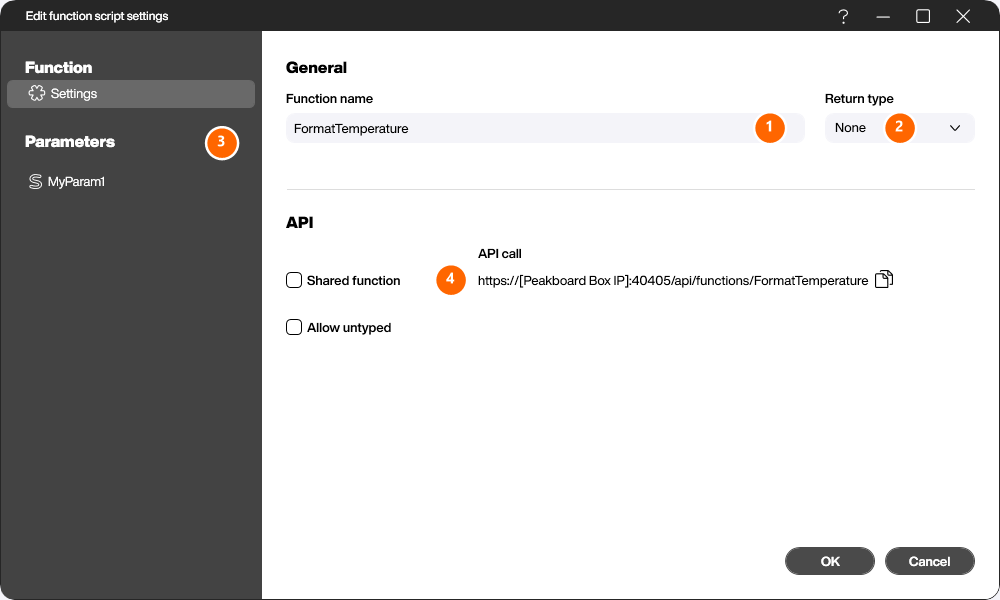
- Function name (1) – the name under which the function is called from Lua, e.g.
FormatTemperature(). - Return type (2) – what the function returns: None, String, Number or Boolean.
- Parameters (3) – add any number of parameters via the [+] button. Each parameter has a name and a data type (String, Number, Boolean) and is available as a local variable inside the function body. Optionally, a parameter can be restricted with a constraint.
- Shared function (4) – exposes the function as a REST endpoint at
https://[Peakboard Box IP]:40405/api/functions/<name>, so it can be triggered from outside the application. [Allow untyped] additionally relaxes the parameter typing for that API call.
Confirm with [OK] to open the script editor and write the Lua body. Parameters are available as local variables; use return to hand back the result. The function is then called from any other script:
-- no parameters
UpdateDashboard()

-- with parameters and a return value
local label = FormatTemperature(21.5)
Global events
Global events apply to the whole application and react to input or system conditions. The e object inside the script carries the event-specific context. When you add a global event you choose its type from the list, which is grouped into five blocks:
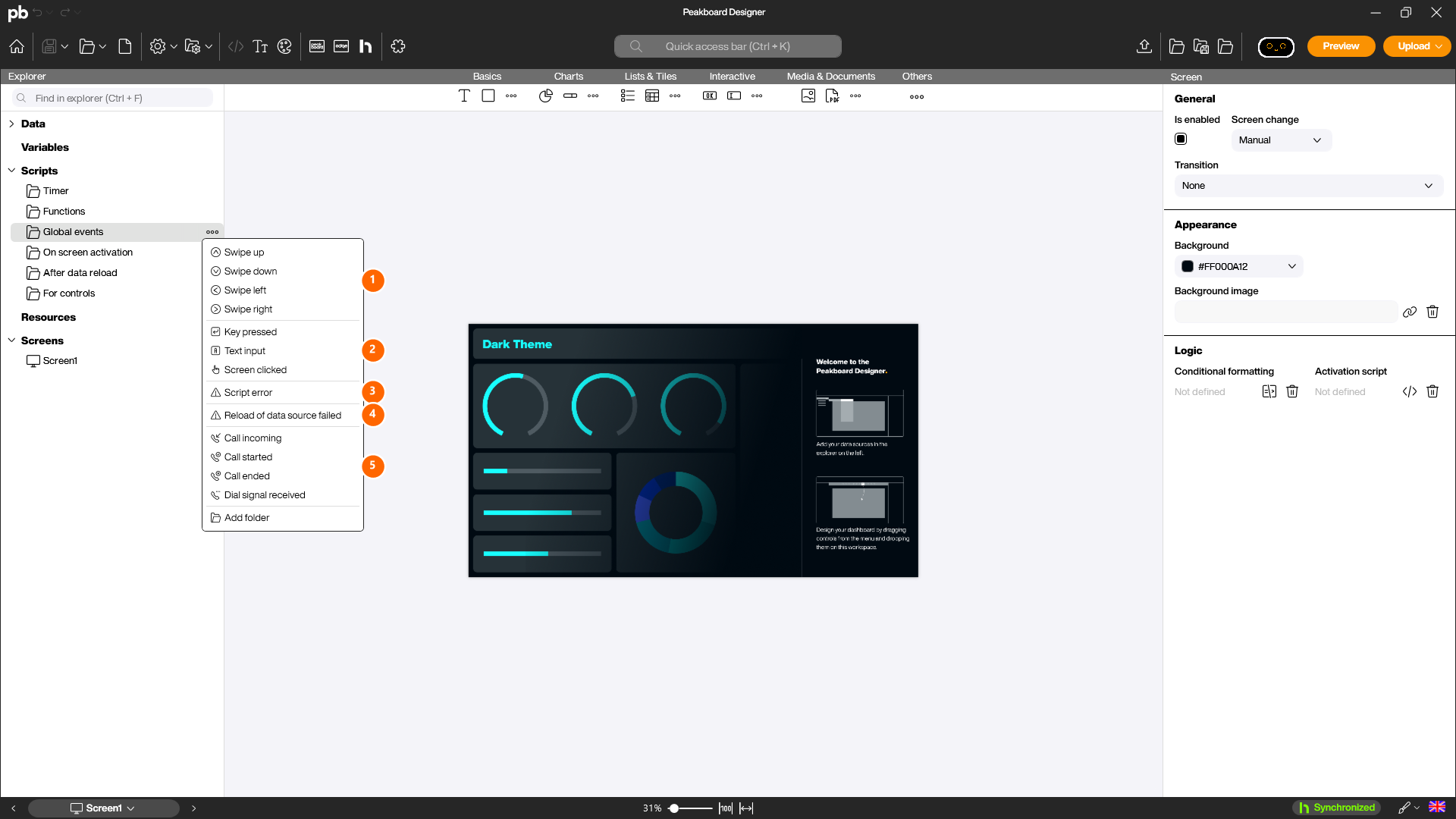
Swipe (1)
Fires when the user swipes on the touchscreen up, down, left or right. A swipe can alternatively be produced with the mouse. These events carry no context data.
Keyboard & screen input (2)
- Key pressed – fires on every single keystroke.
e.keyis the virtual key code,e.modifierthe modifier key; sete.handled = trueto suppress further processing. Useful for input from a Presenter, keyboard or similar device. - Text input – accumulates all typed characters until Enter/Return is pressed, then fires once with the full text in
e.text. Ideal for barcode scanners and RFID readers, which send characters followed by Enter. Usepeakboard.clearinput()to clear the buffer before a scan. - Screen clicked – fires when the screen itself is clicked or tapped outside any control.
Script error (3)
Fires when a Lua script error occurs, so you can react to it centrally.
Reload of data source failed (4)
Fires when a data source refresh fails. e.datasourcename and e.errormessage describe what went wrong.
Call incoming / started / ended / Dial signal received (5)
VoIP/SIP telephony events. They provide the remote endpoint, caller and – for the dial signal – the received DTMF signal digit.
On screen activation
A script defined here runs every time the corresponding screen is activated, i.e. loaded and shown. It is the right place for one-time setup of a screen.
After data reload
This script runs after a data source has completed a refresh cycle (the data element’s Refreshed event). Create it under [Scripts] – [After data reload] via [Add] for the corresponding data source, or by right-clicking the data source.
For controls
Here you find all scripts created via the [Events] function of a control. An event is a specific action that a control can trigger. A selected control (1) exposes its events in the properties panel – e.g. a button’s [Tapped] event (2). The [</>] button (3) opens the script editor for that event.
![A selected control (1), its [Tapped] event (2) and the script button (3)](/assets/images/scripting/types/script-types-04-for-controls.png)
The following list shows every control event and the controls that support it:
Tapped (Button, Text, Text field, Rectangle, Image, Icon)
Fires when the control is activated via touch, mouse or similar input.
TextChanged (Text field, Date picker)
Fires when the text input of the control changes.
SelectionChanged (Dropdown list)
Fires when a new item is selected in the dropdown list.
Checked / Unchecked (Toggle button, Checkbox, Radio button)
Checked fires when the control’s state changes from False to True, Unchecked when it changes from True to False.
Toggled (Toggle button, Checkbox)
Fires when the control’s state changes in either direction (False → True or True → False).
ValueChanged (Slider)
Fires when the value of the slider changes.
DataRowLoaded / CellTapped (Table)
DataRowLoaded fires whenever a new table row is loaded; CellTapped fires when a cell within the table is activated via touch, mouse or similar input.
ElementDropped (List view, Tile view)
Fires when an element is dropped within the list or tile view (drag-and-drop reordering).
AppointmentTapped / EmptySpaceTapped (Scheduler)
AppointmentTapped fires when an appointment is activated; EmptySpaceTapped fires when an empty area of the scheduler is activated.